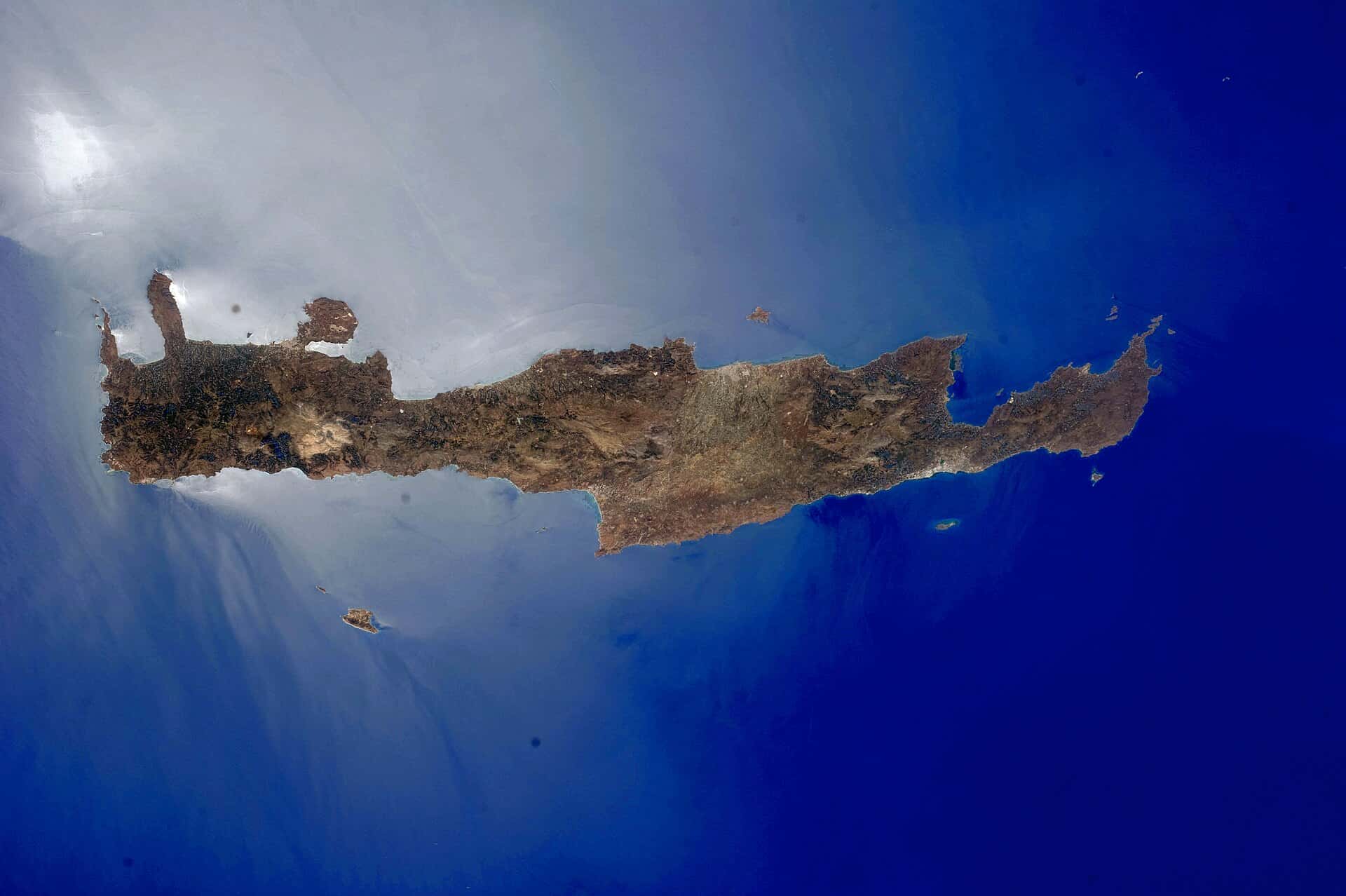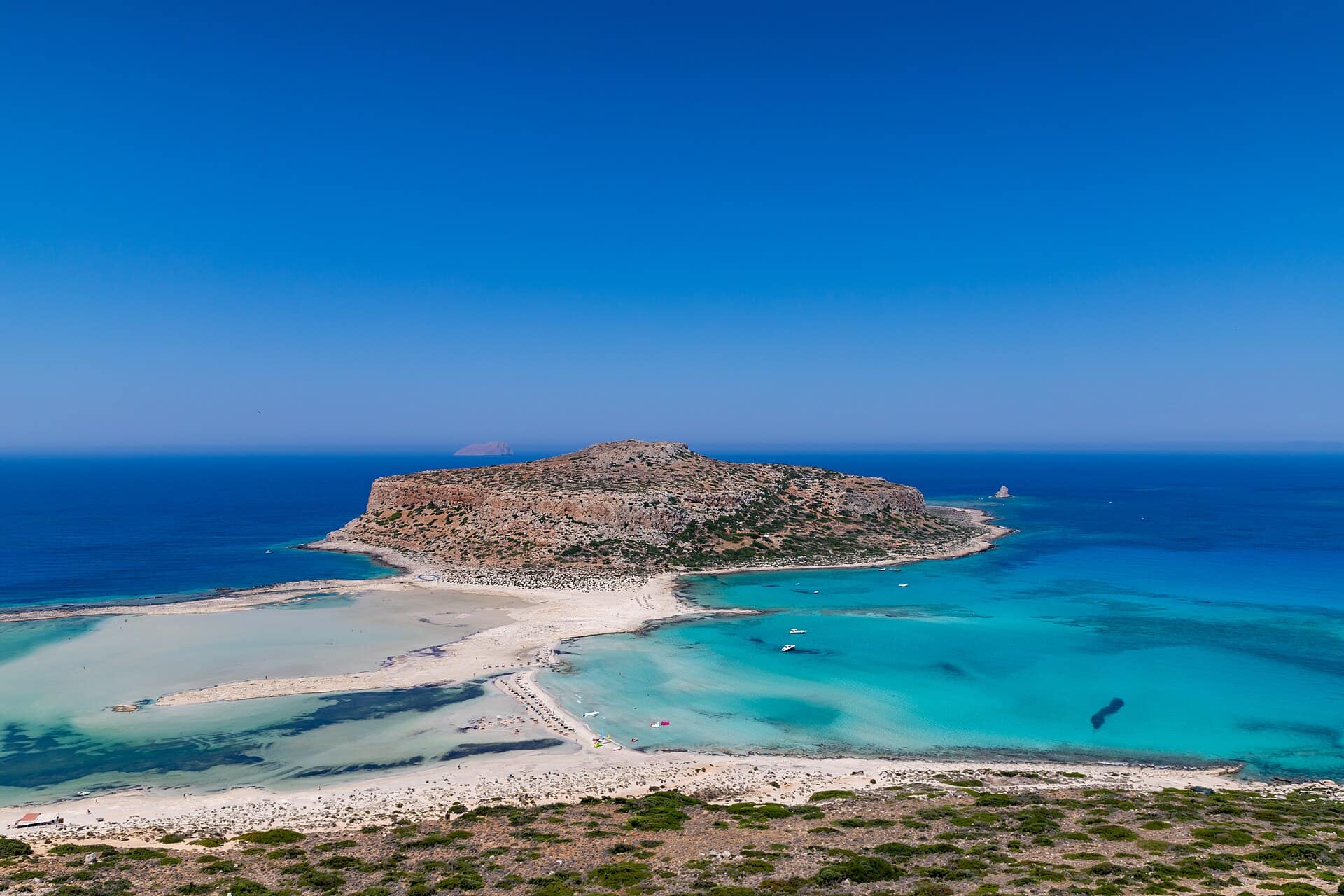
At the far northwest tip of Crete, where the island tapers into a long, rocky peninsula, the sea collects into something almost implausible: a shallow lagoon of palest turquoise, sheltered by sandbars and wading-depth water that shifts from aquamarine to near-white as it approaches the shore. The islet of Imeri Gramvousa rises nearby, crowned by a Venetian fortress that somehow makes the whole scene even more unlikely. Balos is as extraordinary in person as any photograph suggests — provided you arrive at the right moment, and with a clear sense of how you want to get there.
There are two honest approaches, and neither is quite what a casual internet search might lead you to expect. The more straightforward option is the boat from Kissamos harbour, the small port town to the south. The crossing takes roughly an hour, the boats typically pause at Imeri Gramvousa so passengers can climb to the fortress — a rewarding detour in itself, with wide views across the Aegean and the Gulf of Kissamos — and then continue to the lagoon. It is an uncomplicated way to spend a day, particularly if you are travelling with children or anyone who would find the alternative rather daunting. The early sailing is always worth prioritising; the lagoon feels entirely different before the bulk of the day's visitors have settled in.
The second route requires more from you, but gives back accordingly. A rough, unpaved track runs north from a junction near Kaliviani, along the spine of the Gramvousa peninsula, eventually reaching a car park with a view that stops most people in their tracks. From up here, looking down, the lagoon appears as a perfect brushstroke of colour between the bleached peninsula and the open sea. The descent to the water is on foot, and first-timers are often surprised by how long it takes — the path looks short from above, but it involves loose stone, some steep sections, and almost no shade. A sturdy vehicle is advisable for the track itself; ordinary hire cars have been known to struggle. Bring far more water than you think necessary, and sun protection that will survive a long day in direct light.
What awaits at the bottom justifies the effort. The sand at Balos is famously pale, with a faint pinkish cast in certain lights — attributed to crushed shells and fine marine material worked into the grains over centuries. The lagoon is extraordinarily shallow in places, so shallow that adults can wade considerable distances across it, the water barely reaching the knee. The colour shifts constantly depending on the angle of the light, from pale jade to something approaching chalk-white at the sandbar's edge, then deeper blue beyond. It is one of those places that appears almost edited when you see it for the first time, and yet it is entirely natural, shaped by geography rather than human design.
The timing question matters more at Balos than at almost any other beach in Crete, because its reputation is well established and its capacity is, in truth, limited. Mid-summer middays can bring a density of visitors that fundamentally changes the experience — the lagoon remains beautiful, but tranquillity is harder to find. The early hours of the morning, before the boats arrive and before the car park fills, offer something closer to what drew people to Balos in the first place. Shoulder season — typically May, early June, and September — is arguably the finest time of all. The sea in May and early June can still be on the cooler side, though most visitors find it perfectly swimmable; by September the water has accumulated the warmth of the summer and the peninsula carries a quietness that high summer tends to crowd out.
The Venetian fortress on Imeri Gramvousa deserves a moment's attention beyond its role as a scenic backdrop. It is believed to date from the sixteenth century, built as part of the broader Venetian effort to control the approaches to Crete, and the structure remained in use under various occupiers for generations. Its walls are substantially intact, and climbing them — which the boat stop makes possible — offers a perspective on the lagoon that is completely different from the peninsula viewpoint above: the water seen from sea level, framed by old stonework, with the open Mediterranean behind you. The combination of the two views, one from land and one from the water, gives the landscape a satisfying three-dimensionality that photographs rarely capture.
Wherever you choose to base yourself in Crete, Balos rewards an early start and a flexible day — which is precisely what a private villa allows. The private villas available across Heraklion, Lasithi, Rethymno and Chania each offer the kind of independence that makes a long journey to the northwest tip of the island feel entirely natural: your own kitchen for an unhurried breakfast before the road, your own space to return to when the afternoon heat has made the lagoon rather less serene than the morning promised.