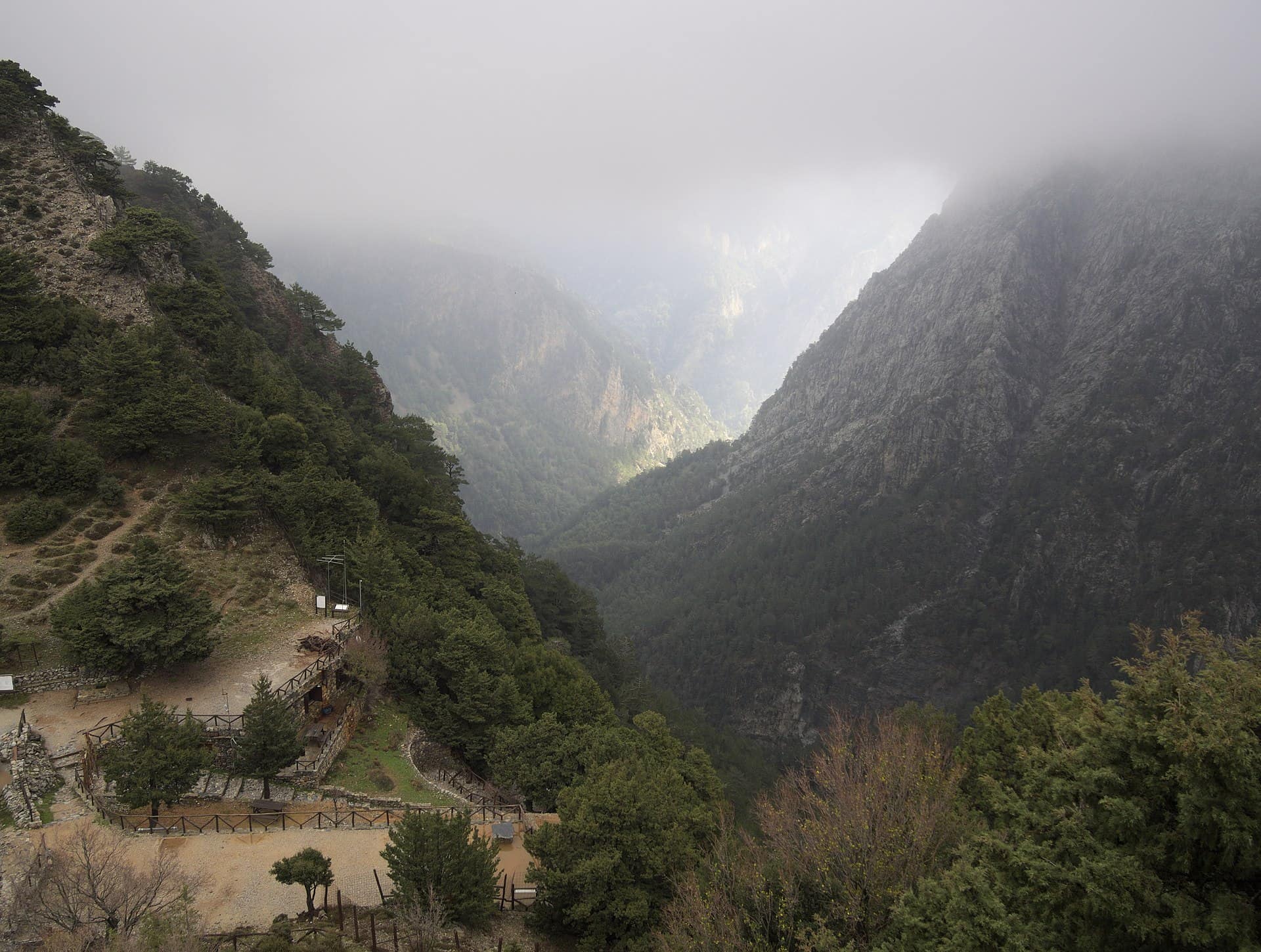
At roughly 16 kilometres, the Samaria Gorge is one of the longest walkable gorges in Europe, cutting through the heart of the White Mountains — the Lefka Ori — from the Omalos plateau in the interior of Chania prefecture all the way down to the Libyan Sea. Typically open from early May to mid-October, conditions permitting, it draws walkers from across the world not because it is technically demanding, but because the landscape it moves through is simply unlike anywhere else on the island. The gorge is a national park, carefully managed, and the walk through it has a rhythm entirely its own — long, gradual, and cumulative in the way that only a full day on foot can be.
The day begins early, and intentionally so. Most walkers set out from the top of the gorge at Xyloskalo — the name translates roughly as wooden staircase — shortly after the gates open, both to avoid the worst of the summer heat and to have a reasonable chance of reaching the coast in good time, since the ferries that serve the village at the end do not run late into the evening and the return journey warrants planning before you start. The descent from the Omalos plateau is steep and immediate: a long series of wooden-stepped switchbacks drops through fragrant pine forest, the air still cool and carrying a faint resinous scent, the views opening briefly before the path pulls you down into the gorge proper. It is a proper beginning — a physical commitment that signals clearly what kind of day this will be.
The gorge changes character as you move through it. In the upper reaches the path follows the dry or trickling bed of the Tarraios river, moving between rocky terrain and scattered plane trees and cypresses. The abandoned village of Samaria sits at roughly the halfway point, its roofless stone buildings slowly being reclaimed by the hillside — a quiet place to stop and eat before the second half. Here the scale of the walk becomes fully apparent, the walls rising on either side, the sky reduced to a ribbon above. It is also where many walkers make their first mistake and push on too fast, treating the second half as a victory lap. The path remains uneven underfoot all the way to the coast, and pace matters considerably.
The most celebrated moment of the walk comes roughly four kilometres from the end, at the Sideroportes — the Iron Gates. Here the gorge walls close to a width of just a few metres while rising to over 300 metres on either side, and walkers pass in single file through the shadows. It is genuinely dramatic and genuinely brief: the passage lasts only minutes, but it tends to stay with people in the way that landscape occasionally does when it exceeds what photography can hold. Emerging from the Gates, the path widens, the vegetation shifts, and the first suggestion of sea air arrives before you actually see the coast. The kri-kri — the Cretan wild goat, found in very few places outside Crete — inhabits these heights and is occasionally spotted picking across the rock faces with a confidence that makes a careful human footstep look rather laboured.
What the walk demands, practically speaking, is more about preparation than fitness. The descent is almost continuous and places real strain on the knees, particularly on the upper Xyloskalo section. Walking poles are worth carrying. Footwear matters enormously: the path is uneven and often wet in sections, and light trainers are a common source of regret before the halfway point. Natural springs exist along the route and in most years provide reliable water, though carrying your own supply remains wise, particularly in high summer when the heat inside the gorge can be significant even on days that feel mild at the top. Food is scarce along the route, and walkers should not rely on finding refreshments between the start and the coast, so whatever is in your bag at Xyloskalo is what you should plan on having for the duration.
For those who want the experience of a Cretan gorge without the full commitment of Samaria, the Imbros Gorge — also in Chania prefecture, accessible from the village of Imbros — offers a shorter and somewhat less crowded alternative, typically walkable in two to three hours. It is a genuinely beautiful walk in its own right, and its more manageable length makes it well suited to families or to days when a full Samaria traverse feels like too much. The two walks are different enough in scale and atmosphere that doing both, if time allows, is far from redundant.
At the end of the Samaria Gorge, the path delivers you to Agia Roumeli, a small settlement on the Libyan coast reachable only by sea or on foot — there is no road in. Boat services connect it to the ports along that south coast, and onward connections by road back to wherever you are staying are worth arranging before the day begins rather than improvising at the end of it. Arriving by boat along that south coast, the White Mountains now rising behind the gorge you have just walked through, is a particular kind of satisfaction — and one that sits rather well at the end of a day that began before dawn in the cool of the Omalos plateau. Private villas across Heraklion, Lasithi, Rethymno and Chania make a natural base for a walk of this scale: somewhere unhurried to return to when the mountain has done its work.
Hero image: C messier / CC BY-SA 4.0, via Wikimedia Commons