A few kilometres south of Heraklion, on a low hill that has been continuously inhabited for longer than almost anywhere else in Europe, stands the Palace of Knossos. Archaeologists reckon the site has seen settled life for roughly nine thousand years, making it one of the earliest urban centres on the continent. But it is the Bronze Age palace complex — the administrative and ceremonial heart of Minoan civilisation at its zenith, sometime around 1700 to 1450 BCE — that draws visitors from across the world. To arrive here is to step into the oldest chapters of western civilisation, and if you come prepared, it can be one of the most rewarding visits you make on the island.
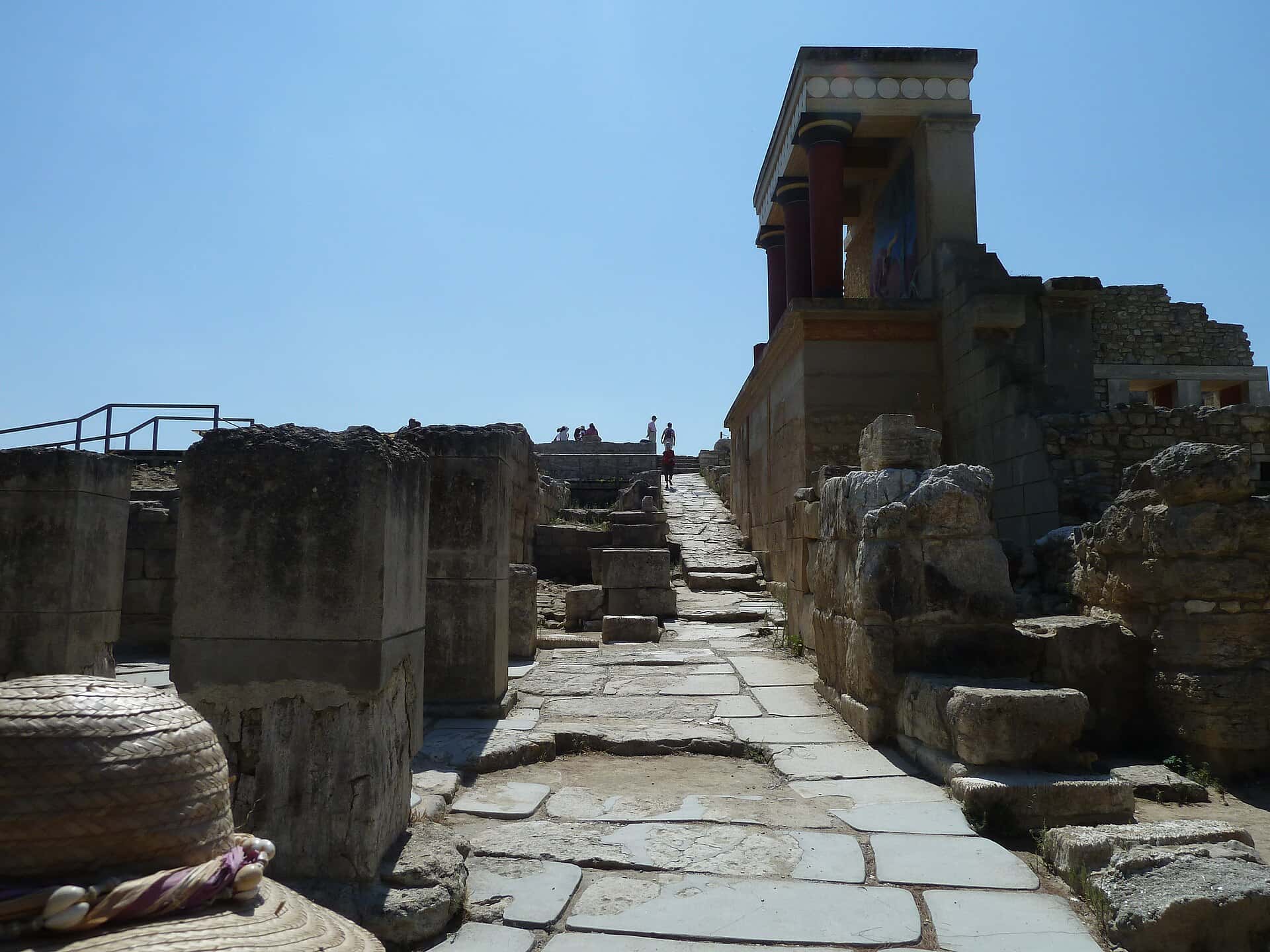
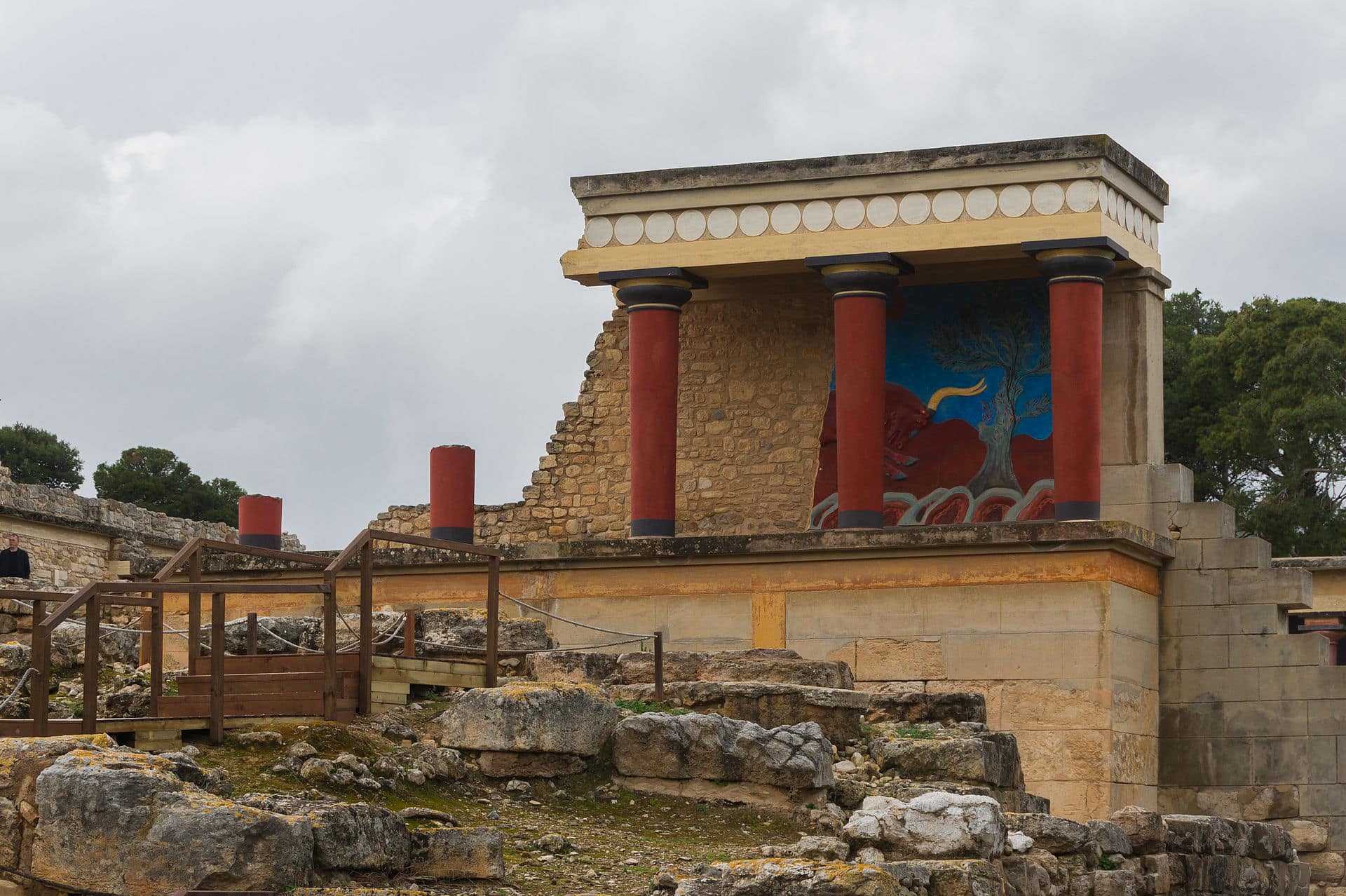
The site owes its present form, for better or worse, to Sir Arthur Evans, the British archaeologist who purchased the land and began excavating in 1900. What he uncovered astonished the scholarly world: a multi-storey palace of extraordinary complexity, with running water, drainage systems, light wells, and walls that had once blazed with vivid painted plaster. Evans went further than excavation, however. He oversaw a partial reconstruction — concrete columns painted terracotta red, restored upper storeys, replicated frescoes fixed back onto walls — that remains controversial to this day. Some scholars argue his interpretations were imaginative to the point of distortion; others maintain that his interventions, however imperfect, allow ordinary visitors to grasp the scale and sophistication of what stood here. Both positions have merit. It helps to arrive knowing that Knossos is simultaneously an archaeological site and a twentieth-century vision of antiquity layered on top of it.
Even with that caveat in mind, the physical experience of wandering the palace is genuinely arresting. The north entrance draws you in with a replica of the Charging Bull fresco — the original resides in the Heraklion Archaeological Museum — its image already insisting that this was a culture of ceremony, movement, and artistic confidence. Deeper into the complex, the so-called Throne Room presents what has long been described as the oldest throne still in situ in Europe: a wavy-backed gypsum seat set into a wall of painted griffins, flanked by stone benches where courtiers or priests may once have gathered. Whether the room served a king or a priest-queen or some function we have not yet correctly imagined, the atmosphere is peculiar and quiet, and it has a weight to it that outlasts the controversy over the reconstruction.
The Grand Staircase is another moment that recalibrates your sense of the ancient world. It descends through several storeys of the east wing, drawing in natural light through the shaft above, and the engineering logic of it — a building designed around the movement of daylight — speaks to a civilisation that was solving problems of comfort and beauty simultaneously. Elsewhere on the site you encounter storage magazines still holding the remnants of enormous ceramic pithoi, and the fragmentary outlines of workshops, theatral areas, and residential quarters. The palace was not a single building so much as a small city compressed onto a hillside. And it is here that myth and archaeology become entangled in the most compelling way: this is the labyrinth, or at least the place that inspired it. The sheer density of interconnected rooms, corridors, and stairwells that Evans uncovered is thought by many scholars to be the kernel of the legend — a structure so elaborate that a monster at its centre seemed the only reasonable explanation.
The Minotaur, the labyrinth, the thread of Ariadne, the hero Theseus: these stories were already ancient when classical Greeks recounted them, and Knossos is where they took root. Walking the site, it is not difficult to feel why. The Minoans left no deciphered written history in a language we can read — Linear A script remains undecoded — so what we know of them comes almost entirely from their art, their architecture, and the later myths of the Greeks who looked back on them with a mixture of awe and unease. That interpretive silence is part of what makes Knossos strange and compelling in a way that more thoroughly documented ruins sometimes are not.
A word on timing, because it matters considerably. In the summer months, coach and cruise traffic can mean the site becomes very crowded during mid-morning hours in most years, and the heat on an open archaeological site under a Cretan July or August sun is not trivial. Those who arrive early when the site first opens, or who visit in the quieter late afternoon, typically find the experience a different thing entirely — unhurried, contemplative, with room to stand still in the Throne Room without a crowd pressing behind. The shoulder seasons, spring and early autumn, are by many accounts the ideal conditions for Knossos: the light is extraordinary, the temperature cooperative, and the site takes on a calm that rewards slow looking. Going with a knowledgeable guide, whether arranged in advance or found through your accommodation, transforms the experience; the ruins without context can feel fragmentary, whereas a good guide stitches the fragments into something coherent and alive.
Knossos should not be visited in isolation. Many of the celebrated frescoes associated with the palace — among them the Ladies in Blue, the Prince of the Lilies, and other works recovered during excavation — were removed long ago for conservation and now live in the Heraklion Archaeological Museum, a short distance away. The two sites are genuinely a pair: the palace gives you the space and the scale, the museum gives you the colour and the human detail. To see one without the other is to read half a sentence. Pairing time at Knossos with a visit to the museum, whether on the same day or across two, is one of the most satisfying cultural combinations Crete offers, and it provides an understanding of the Minoans that no amount of background reading quite replicates. For those staying in a private villa — whether in Heraklion, Lasithi, Rethymno, or Chania — both sites are within reach of the island's well-connected road network, and there is something quietly right about returning afterwards to the unhurried rhythm of a villa, carrying the weight of what you have just seen.